
43 lines
3.1 KiB
Markdown
43 lines
3.1 KiB
Markdown
## transcribe
|
|
Simple script that uses OpenAI's Whisper to transcribe audio files from your local folders.
|
|
## Note
|
|
This implementation and guide is mostly made for researchers not familiar with programming that want a way to transcribe their files locally, without internet connection, usually required within ethical data practices and frameworks. Two examples are shown, a normal workflow with internet connection. And one in which the model is loaded first, via openai-whisper, and then the transcription can be done without being connected to the internet.
|
|
|
|
### Instructions
|
|
#### Requirements
|
|
1. This script was made and tested in an Anaconda environment with python 3.10. I recommend this method if you're not familiar with python.
|
|
See [here](https://docs.anaconda.com/anaconda/install/index.html) for instructions. You might need administrator rights.
|
|
2. Whisper requires some additional libraries. The [setup](https://github.com/openai/whisper#setup) page states: "The codebase also depends on a few Python packages, most notably HuggingFace Transformers for their fast tokenizer implementation and ffmpeg-python for reading audio files."
|
|
Users might not need to specifically install Transfomers. However, a conda installation might be needed for ffmepg[^1], which takes care of setting up PATH variables. From the anaconda prompt, type or copy the following:
|
|
```
|
|
conda install -c conda-forge ffmpeg-python
|
|
```
|
|
3. The main functionality comes from openai-whisper. See their [page](https://github.com/openai/whisper) for details. As of 2023-03-22 you can install via:
|
|
```
|
|
pip install -U openai-whisper
|
|
```
|
|
4. There is an option to run a batch file, which launches a GUI built on TKinter and TTKthemes. If using these options, make sure they are installed in your python build. You can install them via pip.
|
|
```
|
|
pip install tk
|
|
```
|
|
and
|
|
```
|
|
pip install ttkthemes
|
|
```
|
|
#### Using the script
|
|
This is a simple script with no installation. You can either clone the repository with
|
|
```
|
|
git clone https://github.com/soderstromkr/transcribe.git
|
|
```
|
|
and use the example.ipynb template to use the script.
|
|
**OR** download the ```transcribe.py``` file into your work folder. Then you can either import it to another script or notebook for use. I recommend jupyter notebook for new users, see the example below. (Remember to have transcribe.py and example.ipynb in the same working folder).
|
|
#### GUI
|
|
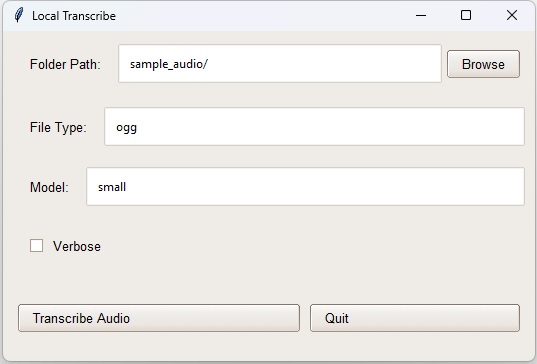
You can also run the GUI version from your terminal running ```python GUI.py``` or with the batch file called run_gui.bat, just make sure to add your conda path to it. It should look like this:
|
|
|
|
### Example
|
|
See [example](example.ipynb) for an implementation on jupyter notebook, also added an example for a simple [workaround](example_no_internet.ipynb) to transcribe while offline.
|
|
|
|
[^1]: Advanced users can use ```pip install ffmpeg-python``` but be ready to deal with some [PATH issues](https://stackoverflow.com/questions/65836756/python-ffmpeg-wont-accept-path-why), which I encountered in Windows 11.
|
|
|
|
[](https://zenodo.org/badge/latestdoi/617404576)
|